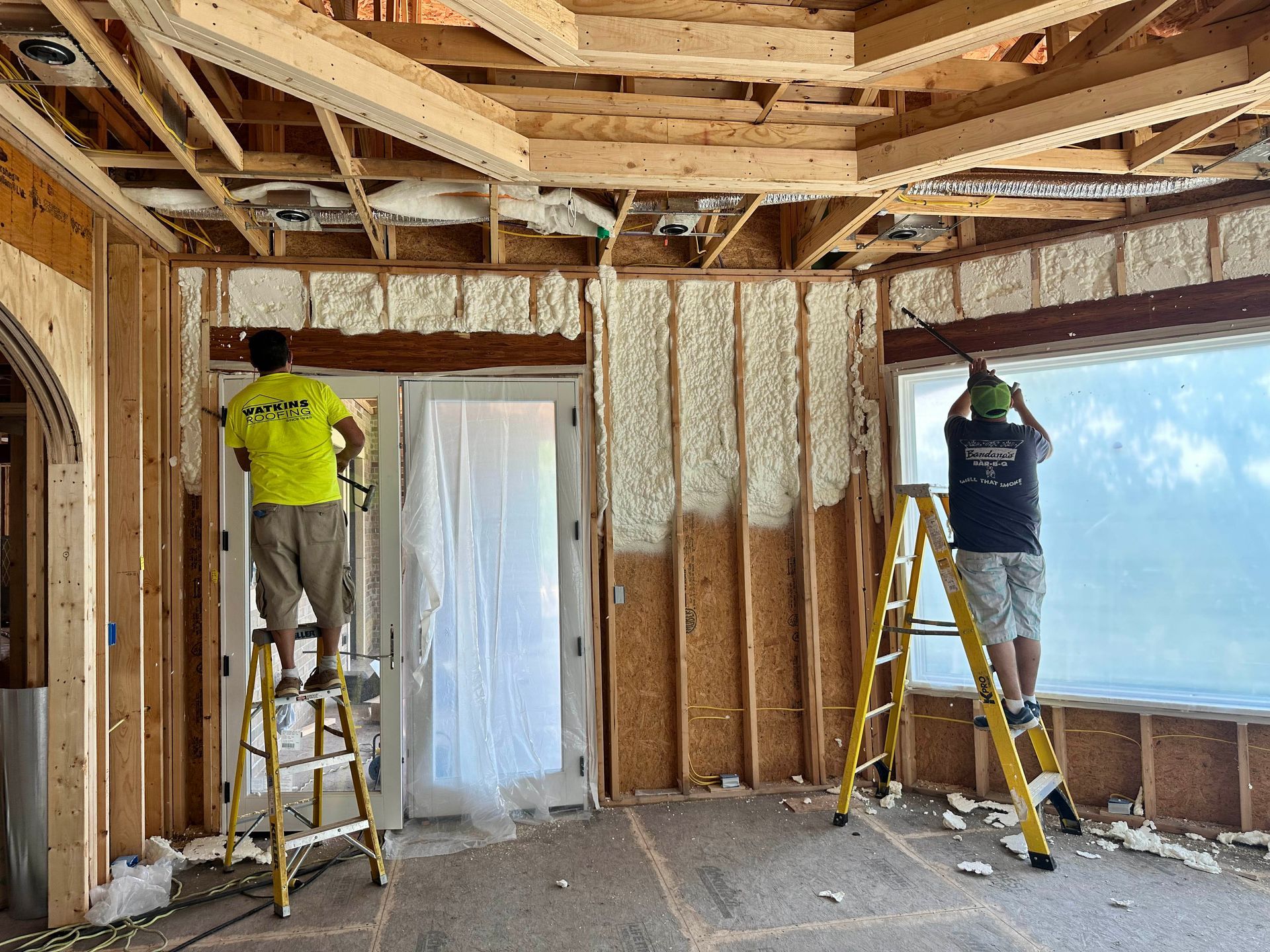
Open Cell vs. Closed Cell Spray Foam in Mid-Missouri: Which One Does Your Home Actually Need?
Walk into any conversation about spray foam insulation and within two minutes someone's going to ask: open cell or closed cell? It's the first real decision in any spray foam project, and it's one that confuses a lot of Mid-Missouri homeowners and contractors — partly because both products look similar during installation and partly because the difference isn't always explained clearly. Here's the honest breakdown of what each product does, where each one belongs, and how to think through the choice for your specific project.
The Fundamental Difference
Both open cell and closed cell spray foam start as liquid chemicals that react and expand when mixed — that's where the similarity ends. In open cell foam, the cells that form during expansion are intentionally left open, creating a soft, spongy material with a lower density. It expands dramatically — up to 100 times its original volume — filling irregular cavities completely. The open cell structure means air can move through the material slowly, and the foam itself is not water-resistant.
Closed cell foam cures into a rigid, dense material where every cell is sealed shut and filled with a blowing agent gas. It expands far less than open cell — about 30–40 times — but the resulting material is waterproof, significantly stronger structurally, and has a much higher R-value per inch. It also acts as a vapor barrier, which matters a great deal in Missouri's climate.

R-Value: Where the Numbers Actually Matter
Open cell spray foam achieves approximately R-3.5 to R-4 per inch. Closed cell achieves R-6 to R-7 per inch — nearly double. In applications where depth isn't limited, open cell can reach adequate total R-values. In tight applications — a 2x4 wall cavity, a rim joist, or a location where depth is constrained — closed cell's higher R-value per inch is the only way to hit requirements without sacrificing structural space.
For most Jefferson City and Mid-Missouri residential and commercial applications, the right product depends on where it's going and what it needs to accomplish. That's a conversation worth having before any material is ordered.
Where Each Product Belongs
Open cell spray foam is the right choice for: interior wall applications where air sealing and soundproofing are the primary goals, and interior spaces where moisture management isn't a concern. It's soft, flexible, and excellent at filling irregular cavities completely.
Closed cell spray foam belongs in: exterior wall assemblies where both insulation value and vapor control matter, metal buildings and pole barns where condensation prevention is critical, rim joists and foundation applications where moisture exposure is a real risk, and any application where structural rigidity or water resistance is needed. In the Jefferson City and Mid-Missouri area, closed cell is the dominant choice for commercial and agricultural applications.
The Cost Difference — and Why It's Not the Whole Story
Closed cell costs more per square foot than open cell — typically 1.5 to 2 times the material cost. That can make open cell look like the obvious budget choice. But the calculation isn't that simple. If a project requires a vapor barrier in addition to insulation, closed cell eliminates that separate installation. If the application requires a specific R-value in limited depth, open cell may not be an option at all.
Xtreme Foam's estimators look at each project individually and recommend the product that fits the application — not the one with the higher margin. A free estimate is the right starting point for any project where you're not sure which way to go.
Not sure which foam is right for your project? Xtreme Foam Insulation offers free estimates for homeowners and contractors throughout Jefferson City, Holts Summit, Ashland, Fulton, and across Mid-Missouri.
Contact us.